
The pricing decision platform,
built by pricing experts.
LevelSetter is a pricing decision platform: the decision layer where a B2B software company’s licensing, packaging and pricing decisions are made and validated against its own deals, above the systems that execute them.
Every price change is reviewed and approved by a person before it reaches a customer. LevelSetter computes, simulates and enforces; your team and our experts decide. It runs alongside your CRM and your quoting stack, no rip-and-replace.
surfaced.
architecture intact.
value.
Most B2B software companies run pricing decisions from spreadsheets, slide decks, and institutional memory while their billing systems and CRM track only what already happened. LevelSetter is the layer in between.

Chris Mele
Chris has led every B2B software pricing engagement at SPP since 2014. Ranked #1 on OpenView’s list of B2B SaaS pricing experts. You get the senior in the room — not their junior.
LevelSetter is the infrastructure his team runs. It scales the practitioner judgment in the room — it doesn’t replace it.
Read more about Chris →What changes when
LevelSetter is running.

OSISoft
Acquired by AVEVA (Schneider Electric) for $5B. Pricing architecture survived PE-level due diligence five years post-engagement.

BeyondTrust
Acquired by Francisco Partners for $5.4B. Largest cybersecurity PE deal of 2023. Pricing governance built for enterprise deal complexity.

BambooHR
Stalled at $22M ARR before SPP. North of $180M ARR soon after. Restructured licensing, packaging, and pricing that held as deal complexity scaled.
What LevelSetter sees that
billing and the CRM cannot.
Most pricing tools generate an output and ship it. LevelSetter sits in the layer under the buying motion, sales-led, self-serve or hybrid, and records what buyers do with the offer before a deal closes.
Win/loss records
in product-led motions
In product-led and self-serve motions, vendors usually don’t see who quoted but didn’t buy, which packaging combinations were attempted, or where buyers abandoned the configurator. LevelSetter drives the price on your website and records every quote attempt. The quote-level win/loss signal product-led vendors normally lose becomes a data feed you can act on.
Pre-quote behavior
the CRM never captures
The CRM shows what was sold. LevelSetter shows every package combination the buyer tried before landing, including the ones that didn’t convert. Edition flips, discount probes, abandoned quotes, configuration paths. Where pricing strategy gets validated is in the actions buyers take before they commit, not in the closed deals you already won.
One base across
sales-led and self-serve
Sales-led teams use LevelSetter to drive structured quotes through deal desk. Self-serve teams use LevelSetter to drive the price on the website. Both motions write into the same base — same licensing-metric layer, same packaging boundary, same transaction-data fabric. Quote-level win/loss patterns calibrate the bounds for the next quarter regardless of where the deal was forged.
What runs underneath. The model is fitted to SPP’s pattern library of B2B software deals. Your deals sit in your own separate store, every simulation replays against the version it ran on, the arithmetic is deterministic, and people decide.
See your future state
before you ship the change.
Your proposed pricing, replayed against every deal you have closed. Pricing Architecture Roll-forward plays a proposed architecture against every historical deal: who pays more, who pays less, and what the customer mix looks like under the new model, before it ships.
Customer-by-customer
revenue impact
Every account modeled at line-item granularity under the proposed architecture. Who pays more, who pays less, by how much, by name. Surfaced before the change ships — not after the support tickets start.
Forecast against
your real customer mix
Projected revenue under the new architecture, calibrated against your actual customer base instead of a slide-deck average. A surrogate forecast measured against the customers you have — not the ones a planning template assumes.
Customer-transition
map
Which accounts move cleanly under the new architecture, which need grandfathering, which need a custom transition path. Informed by the architecture and the deal record — not by whoever applies the most negotiation pressure after the change ships.
Architectural read on
what’s driving the shifts
Which axis — value metric, packaging, price level — is producing each impact, and what the architectural fix looks like. Interpretation comes from the SPP team in the room. Not a dashboard reading numbers back at you.
How it runs:
define, deploy, defend.
LevelSetter is no dashboard you check quarterly. It sits underneath your existing systems, where the pricing architecture is checked, governed and kept current, in three phases your team runs with our experts.
DEFINE your
pricing architecture.
Iterate on the same cadence your team ships product. Test pricing assumptions against your customer base before they reach a contract.
Every architectural change runs through LevelSetter before it ships: versioned, auditable, stress-tested against the customer base you actually have.

This is what runs inside LevelSetter:
Data
loading
Load any data shape. Hundreds of unique input formats, from enterprise SKU complexity to simple subscription billing exports. CRM, ERP, billing, CSV, legacy spreadsheets, all reconciled into one pricing-aware schema.
Data
transformation
ETL built in: extract, flag problematic transactions, iterate with corrected or additional data later. Everything feeds simulation instantly.
Packaging
inputs
Customer mix, value drivers, capabilities and customer-group differentiation become draft packaging the team iterates on, with the tradeoffs modeled.
Pricing Surface
Optimization
Millions of scenarios, one best answer: the optimal pricing surface for a given revenue target, including how legacy accounts move forward without breaking.
Pricing Surface
Simulation
Compare revenue outcomes side by side, each on its own optimized surface, and pick the risk profile your board can live with before prices ship.
DEPLOY your new
pricing architecture.
Deployment fails when the existing customer base is treated as a footnote.
Most consultancies hand off a recommendation and leave the rollout to you. The architecture is modeled against your real book before it leaves LevelSetter, defensible to your board and survivable for your sales team.
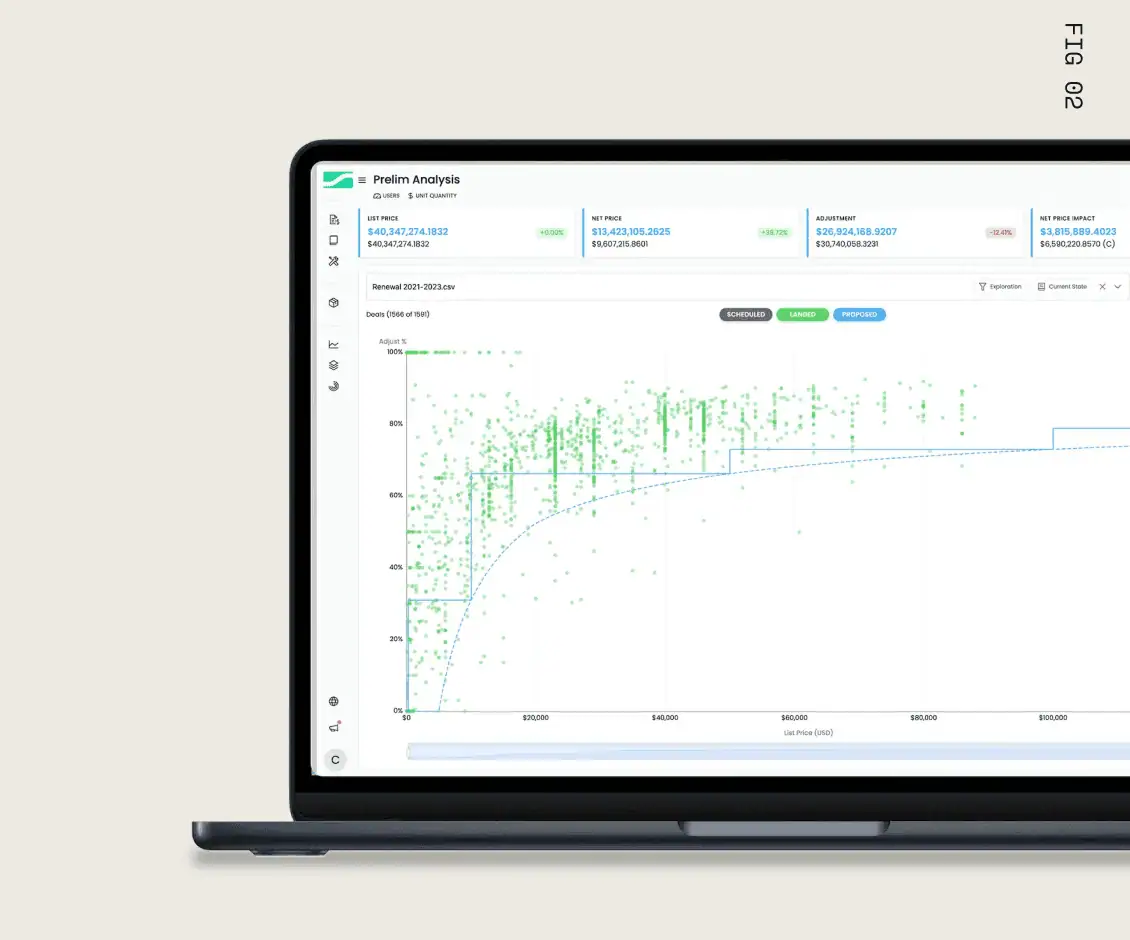
This is what runs inside LevelSetter:
Customer transition
modeling
Every active contract mapped against the new system: pricing migrations, renewals, grandfathering and custom transitions surfaced before deal cycles start. The work that determines whether the change ships at all.
Competitor
triangulation
What comparable customers paid for comparable products in your competitive set. Triangulated across signals (deal patterns, structured dialogue, public filings) so the new model plays out in the field, not just in the deck.
Self-serve
API
Pricing models via API: drive in-app self-serve pricing, track what prospects explore before they close or leave, and feed it back into the next iteration.
Customer
budgeting
For highly variable value metrics, embed LevelSetter in your software and admin panels so customers tour the pricing model, forecast next year’s spend and plan.
Integrations
Native integrations with Salesforce, Zoho, HubSpot and the major CRMs, plus billing systems, ERPs and data warehouses: pricing-aware quoting inside the deal flow your reps already use.
DEFEND your
value.
Deploy through Guardrails. Pricing stops being a project and becomes a continuous capability.
The simulation from DEFINE becomes the live baseline. LevelSetter watches every closed deal against it and flags drift at deal stage; people decide, through the approval gates, discount guardrails and quoting rules of the deal desk.

This is what runs inside LevelSetter:
Guardrails
Approval gates and discount guardrails your deal desk sets from your own deal history. Standard deals close fast; real exceptions route to the right approver, with the pricing model and assumption health visible at every approval.
Quoting
system
No CPQ rip-out. LevelSetter’s quoting runs behind your existing sales motions or surfaces as the deal tool reps reach for; some clients retire the CPQ later.
Pricing
Studio
The sales-side workspace: walk a prospect through the pricing architecture in real time, spin off options, compare deal economics side by side, roll back to any version.
Monitoring
Architecture drift, assumption staleness, buyer-behavior shifts and ethically sourced competitive moves: the pre-deal signals billing systems and CRMs cannot see.
Refusals
Every quote moves through versions, and most quoting systems keep only the one that signed. Refusals reads the versions a buyer walked away from, the record of where a price stopped working, and names the patterns it finds against the pattern library, each with its evidence and an owner.
What it replaces.
LevelSetter runs alongside your CRM, and can replace your CPQ, quoting, and deal desk software if you want consolidated pricing operations.
Spreadsheet
pricing models
Static, unversioned, no simulation. LevelSetter replaces it with version-controlled architecture.
Consultant
slide decks
Recommendations age on a shelf. LevelSetter, SPP’s pricing decision platform, turns strategy into a system.
Ad-hoc
discounting
Leadership finds out at the quarterly review. LevelSetter replaces the free-for-all with structured governance.
Invisible
buyer behavior
The CRM shows what was sold, never which packages buyers explored. LevelSetter makes that visible.
Standalone
CPQ tools
CPQ records what was sold without seeing whether it should have been. LevelSetter replaces it or sits alongside it.
Disconnected
deal desks
Approval workflows disconnected from the architecture. LevelSetter puts the pricing model and assumption health in every approval.
Your data doesn’t
need to be clean.
Most companies hesitate because their data is messy. LevelSetter was built for real-world data, not textbook data.
SKU
complexity
Complicated SKU structures, inconsistent formats, on-prem and cloud SKUs side-by-side, exports from systems that no longer exist. LevelSetter’s data transformation normalizes the mess automatically.
Missing
fields
Incomplete records, gaps in deal history, no solid pricebook versioning. LevelSetter infers structure from what exists rather than requiring clean inputs.
Pricebook
reconstruction
LevelSetter reverse-engineers your pricebook and reconstructs how deals were forged across every customer, package and year, even with no clean history.
Start with your own numbers. Pricing Ground Truth reads your closed deals and your price list, same day from intake-complete: what you really charge, where realized price leaks, and the pricing architecture you run. A fixed fee of $15,000, credited in full to whatever comes next.
Start Pricing Ground Truth Or talk it through firstFrequently asked questions
Strategy and infrastructure from the same team.
Designed by the pricing experts who build your architecture, operated by your team every day.
4 minutes, instant scorecard. No sales call.