
Pricing
Ground Truth.
Where the pricing leaks, discipline drift, and licensing-metric mismatches in your deal patterns become visible — read with a pricing architect.
Pricing Ground Truth is SPP’s entry-point paid engagement. Your transactions go in. Structural answers come out.
Most pricing diagnostics deliver somebody else’s opinion in a slide deck, untethered from your salespeople and customer behavior. Pricing Ground Truth pairs LevelSetter’s pattern matching with a pricing architecture expert — surfacing problems and opportunities the day you connect. The buyer-interview and competitive-intelligence layer of a fuller engagement comes next, when the patterns in your own record say it is worth the deeper look.
Won deals, lost deals, every line item, the whole record. Your team sees the patterns. The architect tells you what they mean, where the leverage sits, and what to fix first.
deal patterns.
visibility.
baked in.
Your own numbers,
read the same day.
This is what comes back, in your own LevelSetter tenant on the day your data lands: one figure for what the record supports, where it comes from by layer, and the floor under it.
- 01The figure. What the record supports without asking anyone to remember why a decision was made, with the range it was assessed in.
- 02Where it comes from. Each layer with its confidence: pricebook defects first, discount policy adherence next, each annualized.
- 03The floor. The number nobody has to argue with. Everything above it is a decision, with a name and a date beside it.
LevelSetter · Pricing Ground Truth read on a demo tenant, where fixing the pricing is worth about $3M a year. Illustrative.
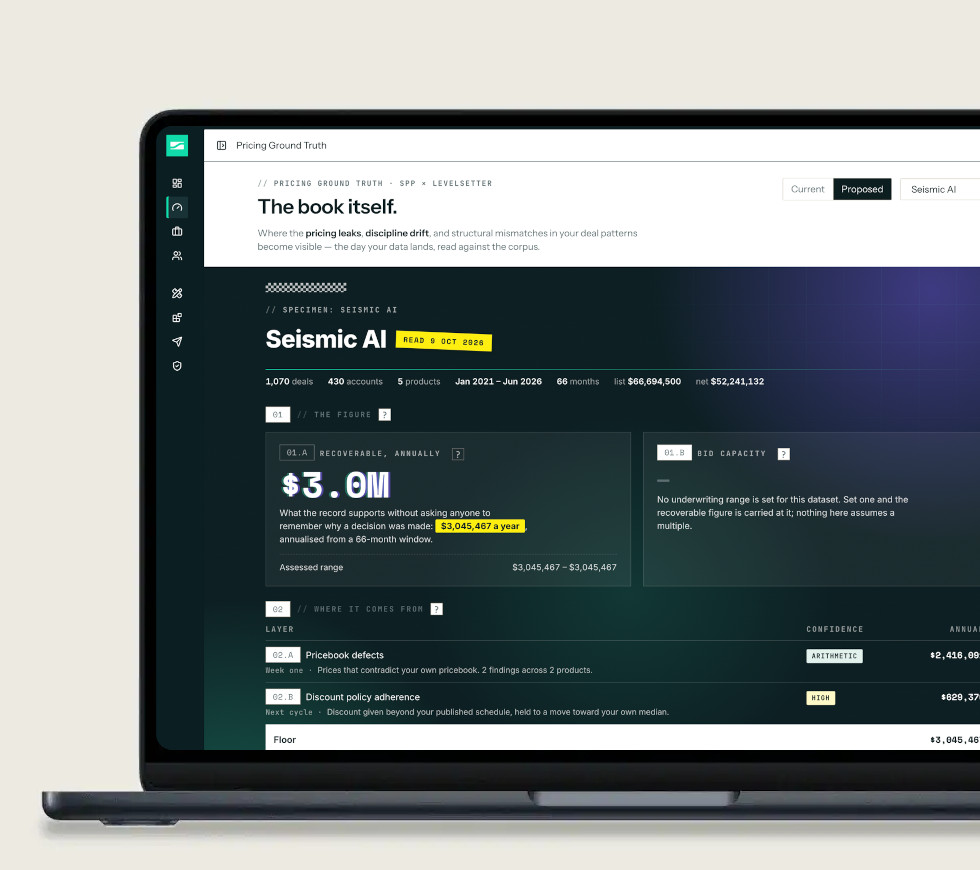 FIG 01
Pricing diagnostics fail the same way every time — framework, recommendations, slide deck, none of it grounded in the pricing leaks, discipline drift, and architecture-layer patterns that emerge from your deal patterns and trends over time.
Pricing Ground Truth flips the order. Transactions first, read against patterns SPP has gleaned from $481B+ of deal patterns across thousands of B2B software companies — interpretation no general-purpose LLM can replicate.

Chris Mele
Ranked #1 on OpenView’s list of B2B SaaS pricing experts. Chris leads every Pricing Ground Truth engagement, surrounded by a team that has held CFO, CPO, and CIO seats inside software companies. You get the pricing architect — not their associate.
LevelSetter does the heavy lifting on loading your data and pattern surfacing.
Read more about Chris →Start Pricing
Ground Truth.
A fixed fee, credited in full to whatever comes next. You send two files. You get your current state back the same day, measured from intake-complete, walked through with you in one session.
What you send
Your price list and your closed deals, exported as they are from your sales system. No personal data; customers coded. The LevelSetter integrity checks run on arrival, and intake is complete when both files are loaded and the checks pass.
What comes back
A same-day read in your LevelSetter tenant: what you really charge against the pricebook, where realized price leaks, and the pricing architecture you actually run. A verdict and the priorities it points to, walked through with you. Recommendations come from the full process, and that is where they stay.
Name, email and company. The intake instructions come back by email, and the two files follow when your team is ready.
Rather talk it through first? Book a working session.
Three things that
change the engagement.
Same-day
reveal
You connect your sales system to LevelSetter. Your transactions go in. Pricing leaks, packaging boundary errors, and licensing-metric mismatches come out — surfaced against the SPP pattern library the day your data lands. Not three weeks later. Not after a discovery sprint. The day you connect. No boutique pricing firm without comparable data infrastructure can match same-day visibility.
Teamed with
a pricing architect
Pricing architecture issues surface in LevelSetter — alongside the quantified upside of fixing each one. A pricing architecture expert reads the patterns with you: what they mean, where the biggest leverage sits, what to fix first. Your team is not asked to trust a framework in the abstract. Your team sees the truth in their own data, validated by someone who has been inside this problem before.
Walk or
continue
The engagement is structured with the exit ramp built in. Once the truth is surfaced, you can act on it independently. Take what you saw, use it inside your company, apply it to your next quarter. If what surfaced justifies deeper work, you continue. Both endings are designed in.
What you see when
the data lands.
Ground Truth surfaces pricing leaks across all three pricing-architecture axes — Licensing Metric (the unit you bind customers to), Packaging Boundary (how capabilities group into editions), and Price Level (list price → net price) — simultaneously. The Licensing Metric is where most pricing-architecture drift originates and where the operative recapture lever almost always sits; Packaging Boundary and Price Level are the supporting levers. The signals live in your deal patterns and trends over time; LevelSetter reads them through the pricing-architecture lens; the expert tells you what they mean.
below the line.
Frameworks · Pricing matrix · Playbooks · Best practices · Recommendations · Slide deck · Maturity model
- licensing-metric mismatch
- licensing-type sprawl
- missed expansion potential
- packaging boundary errors
- edition shelfware
- true discounting picture
- discount drift across reps
- reps off-pricebook
- pricebook structural gaps
- discipline drift
- unrecognized Customer Groups
- Customer Group divergence
- customer behavior patterns
- sales behavior patterns
Licensing
Is your value metric capturing value? Are customers consuming far more (or far less) than the metric reflects? Are won deals holding expansion potential the licensing structure will not capture? Is the meter pricing-in customer pain that is structurally invisible to your billing? You also see licensing-type sprawl, where the team invented variants per customer because the underlying structure could not anticipate the deals being closed.
Offering
Edition-mix patterns across won deals reveal which editions are doing the work, which are competitive shelfware, and which feature gates create buyer friction. The SKU-structure simplification opportunity surfaces directly from line-item evidence. Excess SKUs that never appear in won deals. SKUs that drive negotiation cycles disproportionate to their revenue. Cases where reps quietly stopped using the published package because the math broke under deal pressure.
Pricing
The real discounting picture with nuance, not “you discount too much on average.” Across deal size, customer group, sales rep, product line, and time. The discounts taken at quarter-end. The discounts taken to close named accounts. The discounts compounded on multi-product deals. You see pricebook structural problems, including what is missing. Where the published pricebook fails to anticipate the deal shape your reps encounter.
Cross-axis
patterns
Systemic patterns in sales and customer behavior: seasonality, end-of-quarter timing, cohorts behaving differently. Multi-year trends in discount discipline drift and customer-group mix shift. Drill-down by any dimension you bring: currency, channel, geography, vertical, customer segment, product line. Your team configures the slices that matter to your operating model.
Curious what your own iceberg looks like? Twenty minutes scopes the engagement against your transaction record.
Schedule an orientationThe engagement,
in four steps.
Free orientation call (20 min)
We confirm fit. You leave the call knowing whether Pricing Ground Truth is the right next step and what data we need from your side. No prep required.
LevelSetter portal provisioned
Your team gets accounts. We connect your sales system. The data load runs against your transaction record — won and lost, line items, last twelve to twenty-four months — plus any pricebook, contract-amendment, and renewal-history data you can surface.
Cleanup + self-serve explore
Discounting trends and pricing patterns are visible in LevelSetter the moment data lands. Your team self-serves the exploration — drilling into the dimensions that matter to your business — while LevelSetter handles ongoing data cleanup in the background.
Expert review, on your schedule
You schedule the architect read when your team is ready — same day or over time. The expert walks you through what the patterns mean, where the leverage sits, and what to fix first. The read is yours regardless of what comes next. If the data justifies deeper work, the next engagement is a full Pricing Architecture engagement scoped to the axes Ground Truth surfaced.
Engage at the depth
your data supports.
Pricing Ground Truth adapts to your transaction record’s state on day one. If your data needs cleanup, you can correct at your pace and engage the expert when you’re ready — the engagement runs on your timeline, not ours.
Quick read
When. Day one, even when the transaction record still has gaps.
What surfaces. The first-order pricing leaks and the highest-leverage architecture axis to fix.
Output. Direction. Where your team focuses correction work next.
Comprehensive read
When. After your team has corrected gaps and reloaded.
What surfaces. Every cross-axis pattern. Pricing-architecture-layer signals across Licensing Metric × Packaging Boundary × Price Level.
Output. Quantified upside per lever and the priorities it points to.
Three ways to add the market and your customers to the read, each credited forward the same way:
Pricing Ground Truth with the competitor read
When. You know who you lose to and want their pricing read beside your own.
What surfaces. Live interviews with a cohort of each competitor’s customers: their pricing architecture, where it works and where it does not, and the net prices paid for software and services, set against your own deals.
Pricing Ground Truth with the customer conversations
When. The read names the Customer Groups where price and value have come apart, and you want to hear it from them before you redraw anything.
What surfaces. Structured conversations with four to six customers in each named group, about the value they get and the basis they pay on. No surveys, no willingness-to-pay questions. The read stays same day; the conversations run in the weeks after it.
Sized by the Customer Groups the read names, quoted with the read.
Second Opinion with the competitor read
When. You already have a model, in house, with AI or from another firm, and you want it checked against the market before you commit.
What surfaces. The verdict with ranked fixes from the Second Opinion, plus the competitor reads, priced per competitor and quoted with it.
LevelSetter runs hundreds of integrity checks for the data issues common to B2B software companies, so normalization is immediate and automated, and you read the data with the expert while you clean it. The checks are deterministic: proven, repeatable routines that return the same answer every run, with every figure traced to the rows it came from. That is what separates it from handing your deal file to a general-purpose AI assistant, which reasons its way to a number and can get the arithmetic wrong.
Who Pricing Ground
Truth is for.
Right fit when
- Transaction depth. Twelve+ months in your sales system, ideally twenty-four — won and lost, line items intact.
- External validation needed. You’ve done internal pricing work but want external evidence grounded in your own transactions, not a framework conversation.
- Considering a metric shift. Per-seat to usage, consumption, or outcome-aligned — and you need to model the impact against your own won-and-lost history before committing.
- Architecture suspicion. You suspect something’s broken but can’t tell where, or your internal analysis says one thing while the discount, sales-cycle, or renewal data tells a different story.
- Speed matters. You want the truth this week, not next quarter.
Probably not a fit if
- Pre-revenue or pre-launch. Nothing to load yet — a 20-minute pricing call can scope a different starting point.
- You want a framework lecture, not a working session.
- You want benchmarks that average everyone and explain no one.
- You want the senior partner in the pitch and you’re OK with a junior associate running the actual workstream.
Five scenarios route
into the same diagnostic.
- In a pricing crisis — the symptoms in your deal patterns, not the slide deck.
- Comparing pricing consultants — why same-day data beats slide-deck strategy.
- PE or VC running portfolio analysis — reading one portco vs. cascading the lens.
- Repackaging your offer — the cohorts the new packaging will actually hit.
- Moving from per-seat to consumption — the metric-transition baseline read.
Operating partner at a PE firm? Pricing Ground Truth runs inside the deal before the LOI, and across the portfolio after it, in one view. The investor page has both.
Yours to keep,
regardless of what’s next.
LevelSetter visibility
LevelSetter view of your own transaction-level monetization architecture in operation. What it produces is exportable and permanently yours; the live loop itself runs with an active engagement.
Quantified upside
A quantified read of the dollar opportunity in fixing the broken architecture, scored against your historical transactions. Not directional. Dollarized.
Specific insights
Specific insights from a pricing architecture expert anchored in what your transactions revealed — pricing leaks, discipline drift, and pricing-architecture-layer patterns called out individually across Licensing Metric, Packaging Boundary, and Price Level. Yours to act on independently.
Team-owned drill-down
Your team can drill down further independently because the deliverable is software access, not a slide deck. Yours to revisit when business conditions change.
Pricing architecture
built from the data.
$300M+
When SPP redesigned BambooHR’s architecture (packaging, pricing, and discount guardrails around customer groups identified through usage analysis) their CRO raised the sales forecast 15% month over month during rollout, and they beat plan for 18 consecutive months. BambooHR has since grown past $300M ARR — without needing another round of outside funding after our engagement.
Start with your own numbers. Pricing Ground Truth reads your closed deals and your price list, same day from intake-complete: what you really charge, where realized price leaks, and the pricing architecture you run. A fixed fee of $15,000, credited in full to whatever comes next.
Start Pricing Ground Truth Or talk it through first