
Your model says pricing uplift.
This is the read that tells you whether it is reachable.
Pricing Ground Truth for Diligence runs inside your deal process, on the target’s own record of what it won and what it lost. It reads the licensing grant, the packaging, and the price level in that order, and it names which one is holding the value back. You read it with a pricing architect.
A read counts only when the deal goes through. A read on a process that dies costs you nothing.
Pricing enters most B2B software theses as a value-creation lever with a number attached and three sentences of support. Inside the deal window nobody has time to test whether that number is an architecture fact or a hopeful assumption, so it goes into the model and the operating team inherits it on day one.
This read tests it against the target’s own record of what it won, what it lost, and at what price. That record was not assembled to support anyone’s thesis, which is what makes it worth the window. A pricing architect reads that record with your deal team, and the read says which of the three pricing decisions the upside actually depends on, and whether your hold is long enough to move it.
deal patterns.
data room opens.
that ever count.
The target’s numbers,
read before the LOI.
This is what the deal team opens: one figure for what the target’s record supports, that figure held at your underwriting range, and where it comes from by layer.
- 01The figure. What the record supports without asking anyone at the target to remember why a decision was made, with the range it was assessed in.
- 02Bid capacity at your multiple. The recoverable figure held at the range your deal team set. The range is yours to change; nothing here assumes a multiple.
- 03Where it comes from. Each layer with its confidence, pricebook defects first, and the floor nobody has to argue with underneath.
LevelSetter · Pricing Ground Truth for Diligence on a demo tenant, where fixing the target’s pricing is worth about $24M a year before the multiple. Illustrative.
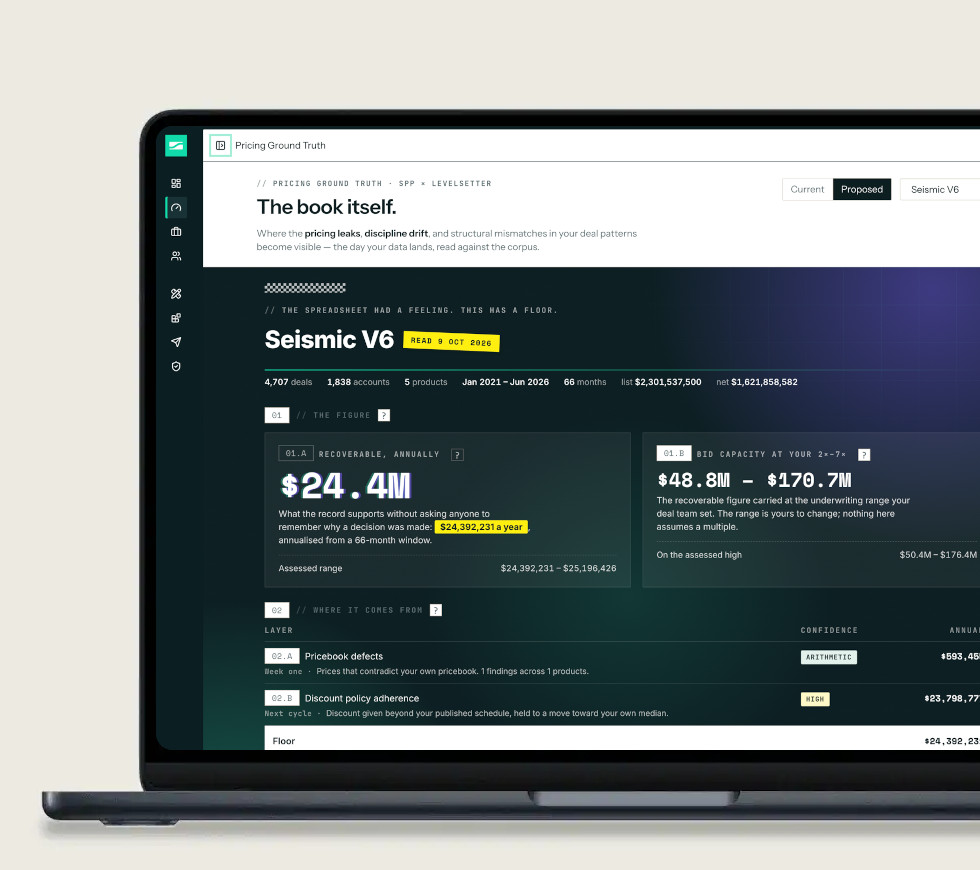 FIG 01
Two ways to read pricing
inside a deal process.
How the pricing question
usually gets read
- Sized on the price level, because that is where the data is cleanest. Realization, discounting, leakage. All three are measurements of the same decision.
- Compared to a central tendency. A ratio, an average, a quartile, with the conditions that produced it stripped off before it reaches your memo.
- Quantified levers promised regardless of what the room actually opened. The confidence in the output does not vary with the evidence behind it.
- Delivered as a document that somebody inside the portco has to rebuild from scratch on day one, usually without the person who wrote it.
How Pricing Ground Truth
reads it
- Licensing grant first, then packaging, then price level, with the binding constraint named. The answer is usually not on the axis with the best data.
- Compared to the target’s own record, won and lost, line by line. Our pattern library supplies the interpretation, not a number to price against.
- Graded by what the room opens, and the grade is stated at intake. A read that cannot support a customer-by-customer view says so rather than implying one.
- Held as live state your team opens, which becomes the portco’s first hundred days if the deal goes through. Nothing gets re-instantiated.
Pricing upside in an underwriting model is a number. Whether it is reachable is an architecture question, and the answer sits in one of three decisions. The read tells you which one, and whether your hold is long enough to move it.

Chris Mele
Ranked #1 on OpenView’s list of B2B SaaS pricing experts. Chris reads every diligence engagement himself, surrounded by a team that has held CFO, CPO, and CIO seats inside software companies. You get the pricing architect, not their associate.
LevelSetter runs the pricing infrastructure end-to-end so the experts focus on the calls only humans can make. It scales practitioner judgment; it does not replace it.
Read more about Chris →The axis with the best data
is not the axis with the answer.
List prices are legible. Discounts are legible. Realized price against list is legible, and a competent read of all three produces a number that survives the investment committee.
The number fails in year two, and it fails for a structural reason. The price level is the last of the three pricing decisions and the most easily papered over at the deal desk. The decision above it, the licensing grant, sets the value metric the target binds its customers to and the rights that come with that unit. When the value metric no longer tracks how customers actually produce value from the product, every renewal becomes a reopening of the structure rather than a negotiation inside it. No amount of price-level discipline fixes that, because the leak is not in the price.
So the question that decides your thesis is not what the target charges. It is which of the three decisions is the binding constraint, and whether it can be repositioned inside your hold.
That is the read. It is a directional starting point that tells you which questions are worth your money, not a set of recommendations. The recommendations are the work that follows, and only if you buy the company.
The test to take into your next diligence call: if this target doubled the value its customers get from the product next year, does the contract capture any of it automatically? If the answer is no, the upside in your model is on the wrong axis.
The published argument behind this section: the licensing-axis question most PE pricing diligence never asks, and the frame for what diligence should cover at LOI, mid-hold, and exit in private equity pricing diligence.
The comparison is the target’s
own record, not somebody else’s average.
A benchmark reports a central tendency and throws away the conditions that produced it. That is a reasonable instrument for a capacity question, where you want to know whether a number is unusual. It is the wrong instrument for a pricing question, because the conditions under which another company realized its price are precisely what decide whether this one can.
Pricing Ground Truth reads the target’s own deals, won and lost, line by line, alongside the pricebook history. Patterns surface out of that record once it is connected. What our pattern library contributes is interpretation: how a mechanism has behaved when we have watched it before, and the conditions under which it held. It is never a number for you to price the target against, and it never references another company’s specifics.
On the data, plainly. What the data room opens determines what the read can say, so the read comes with a grade, and you are told which one at intake.
Deal-level and billing data are on the table.
The read shows the customer-by-customer shape of a repricing before the memo is written: which accounts move, which way, under a change to the metric or the packaging. This is the grade that settles an underwriting assumption instead of qualifying it, and it is the grade that continues straight into the hold if the deal goes through.
No billing data, and the read says so.
The read runs on the pricing and packaging documents the room does hold, the contract terms, the competitive footprint, and category-level patterns. It names the architecture and its binding constraint, and it does not claim a customer-by-customer view the evidence cannot support. You get a shape you can underwrite against, with its limits stated rather than implied.
Have a live process? Tell us which target and where the process stands. A pricing architect reads it and replies with what the record can and cannot settle inside your window.
Talk to a Pricing ExpertState your deal team opens,
not a document you file.
The binding
constraint, named
Which of the three pricing decisions, licensing, packaging, or price level, is holding the value back on this target, what in the record says so, and what repositioning it would take. Not a list of observations, a call with evidence under it.
Monetization
Velocity
Whether this company can change its own pricing, or whether every change needs an outside engagement. A target that cannot move its own price is a different asset from one that can, whatever the architecture says on paper.
The investment-
committee view
A view of that state, exportable into your pack, so the pricing number in the model has the target’s own transactions behind it when somebody asks where it came from.
Drill-down your
team runs
Your deal team explores the record along whatever dimensions came with it: segment, geography, channel, product line, deal size. The read does not pre-decide which slices matter to your thesis.
LevelSetter is the infrastructure underneath. It loads the target’s record in the formats a data room actually holds, so the architect spends a short window reading the evidence instead of assembling it.
The read does not end at signing.
It becomes the first hundred days.
A diligence document has a short half-life. It is written for the investment committee, it wins the vote, and then somebody inside the portco rebuilds the thinking from scratch against a hundred-day clock, usually without the person who did the original work. The number in the model survives; the reasoning behind it does not.
This read does not arrive as a document. It arrives as live state your deal team opens and keeps. If the deal goes through, that same state is where the portco’s pricing plan starts on day one. Nothing is re-instantiated, nothing is re-interviewed, and the architect who read it with you before signing is the one who reads it with the portco after.
That continuity is the reason to run this before the deal closes rather than after. It is also why a counted read is the front end of the hold-period work rather than a separate purchase: the evidence base is already standing when the operating plan needs one.
Once you own the company: the Pre-Shock Read re-runs every historical deal under a proposed pricing architecture before it ships. The full hold-period engagement sits at pricing due diligence for PE software.
We only charge for
the deals you win.
The objection to pricing diligence has never really been the price of the read. It is paying for reads on processes that go nowhere, which for an active firm is most of them.
So the model counts differently. Firms with deal flow hold reads in a pack and draw one down when a transaction goes through. A read on a lost LOI, a withdrawn process, or a deal that never signs is not counted and stays in the pack. A read can also be handed to a portfolio company that wants a Pricing Ground Truth on its own product.
Competitive intelligence on the target’s named competitors, and research with the target’s customers, sit alongside the read and are scoped to the question you are actually asking rather than bundled in by default.
If you run one process at a time, a single read is available on its own, and the outcome of the deal does not enter into it.
What this is not: the read has a price, and that price does not move with the size of the transaction or with what the pricing work later produces. The only thing that changes is whether the read counts at all.
No live process right now?
Then this read has nothing to run on yet, and there is a free rung below it that does. The Pricing Architecture Assessment is free, self-scored, and takes about four minutes. It is not a diligence instrument and it does not read a target. What it does is put the three pricing decisions in front of you in the same vocabulary this read uses, on a company you already own or on a target whose management will run it themselves. It costs nothing and commits you to nothing.
- Operating partner, mid-hold → the portfolio-level lens and the cross-portco story live on pricing diagnostics for PE portfolio companies.
- Already own it and the thesis has stalled → the full diligence and operating engagement picks up where the read stops.
- Reading your own product, not a target → Pricing Ground Truth is the same read on a company you operate.
Frequently asked questions
Tell us which target and
where the process stands.
Send the thesis and the timeline. A pricing architect reads it and replies with what the target’s own record can and cannot settle inside your window, and which grade of read the process supports.
Would rather talk it through on a call? Book a working session. No live process yet? Start with the free four-minute Pricing Architecture Assessment.