
The pricing architecture platform,
built by pricing experts.
Most pricing software automates execution without validating strategy. LevelSetter is built to run the pricing architecture itself — what SPP calls a Continuous Monetization Platform. Pricing and packaging revisions become an on-demand, in-house capability instead of quarters of consulting work. Built by the same team that designs your pricing architecture. Many buyers first experience it through SPP’s entry-point engagement, Pricing Ground Truth.
LevelSetter shows what billing systems and CRMs can’t see: which packages buyers are exploring, where sales behavior diverges from buyer behavior, and which assumptions in your licensing, packaging, and pricing models hold up in the field. Continuous validation, not a quarterly dashboard.
Run it alongside your CRM and your existing quoting stack; no rip-and-replace. Every price change is reviewed and approved by a person before it reaches a customer; LevelSetter computes, simulates and enforces, and your team and our experts decide. Deployed through an SPP continuous monetization engagement and run by your team year over year.
surfaced.
architecture intact.
value.
Most B2B software companies run pricing decisions from spreadsheets, slide decks, and institutional memory while their billing systems and CRM track only what already happened. LevelSetter is the layer in between.

Chris Mele
Chris has led every B2B software pricing engagement at SPP since 2014. Ranked #1 on OpenView’s list of B2B SaaS pricing experts. You get the senior in the room — not their junior.
LevelSetter is the infrastructure his team runs. It scales the practitioner judgment in the room — it doesn’t replace it.
Read more about Chris →What is a pricing
architecture platform?
A pricing architecture platform operates across the three axes of B2B software pricing (value metric, packaging boundary, and price level) instead of optimizing one axis in isolation. CPQ and price-management software automate execution on the price-level axis. LevelSetter is built to run the architecture itself: simulate it, validate it against your transaction record, and operate it continuously after launch.
It is the operational layer of Pricing Ground Truth and every SPP engagement. It is not a replacement for the experts who designed your pricing architecture. The evidence those experts work from is human-made: buyer interviews, win/loss debriefs, and ethically sourced competitive pricing analysis. LevelSetter validates that evidence against your transaction record at a scale no spreadsheet can. It is how those experts stay deployed inside your team year after year — without billing-by-the-hour.
The structured model underneath is the monetization model SPP has operated since 2014: value metric, packaging, and price represented as one system, measured from your transaction record rather than survey hypotheticals. Chris Mele ran it first as a client: his own software company repriced on this model from its 2008 subscription transition on, six years before SPP named the discipline. That makes it infrastructure we have run for over a decade, not a standard you adopt.
LevelSetter is built and maintained by a dedicated product team, not assembled engagement by engagement. Your team builds on maintained building blocks and owns what it assembles: why that beats having a consultancy build you custom AI tools.
See your future state
before you ship the change.
Your proposed pricing, replayed against every deal you have closed. Pricing Architecture Roll-forward plays your proposed new pricing architecture against every historical deal, showing who pays more, who pays less, and what the customer mix will look like under the new model. Three jobs in one run: revenue impact at the line-item level, a forecast surrogate calibrated against your real customer base instead of a slide-deck average, and the transition map for moving legacy accounts onto the new architecture without breaking them. The forward sister to surfacing your current pricing reality with Pricing Ground Truth.
Customer-by-customer
revenue impact
Every account modeled at line-item granularity under the proposed architecture. Who pays more, who pays less, by how much, by name. Surfaced before the change ships — not after the support tickets start.
Forecast against
your real customer mix
Projected revenue under the new architecture, calibrated against your actual customer base instead of a slide-deck average. A surrogate forecast measured against the customers you have — not the ones a planning template assumes.
Customer-transition
map
Which accounts move cleanly under the new architecture, which need grandfathering, which need a custom transition path. Informed by the architecture and the deal record — not by whoever applies the most negotiation pressure after the change ships.
Architectural read on
what’s driving the shifts
Which axis — value metric, packaging, price level — is producing each impact, and what the architectural fix looks like. Interpretation comes from the SPP team in the room. Not a dashboard reading numbers back at you.
What LevelSetter solves
(and what it can replace).
LevelSetter runs alongside your CRM, and can replace your CPQ, quoting, and deal desk software if you want consolidated pricing operations.
Spreadsheet
pricing models
Static, unversioned, no simulation. Every decision starts with “let me update the spreadsheet.” LevelSetter replaces the spreadsheet with version-controlled architecture.
Consultant
slide decks
The engagement ended, the recommendations aged on a shelf, nobody built the infrastructure to operate them. LevelSetter is the infrastructure that turns strategy into a system.
Ad-hoc
discounting
Every deal negotiated from scratch. Leadership finds out at the quarterly review, not in real time. LevelSetter replaces the discount free-for-all with structured governance.
Invisible
buyer behavior
Your CRM shows what was sold, not which packages buyers explored before landing. The pre-deal signal is where pricing strategy gets validated. LevelSetter makes it visible.
Standalone
CPQ tools
CPQ captures what was sold without seeing whether it should have been. LevelSetter can replace your CPQ entirely with a pricing-aware version, or sit alongside one you keep.
Disconnected
deal desks
Approval workflows disconnected from the pricing architecture. LevelSetter consolidates deal desk and quoting into one platform with the pricing model and assumption health visible at every approval.
What your team
operates every day.
LevelSetter isn’t a dashboard you check quarterly. It’s the management layer underneath your existing systems, where pricing architecture gets checked, governed, and kept current.
DEFINE your
pricing architecture.
Iterate on the same cadence your team ships product. Test pricing assumptions against your customer base before they reach a contract.
Every architectural change runs through LevelSetter before it ships. Versioned. Auditable. Stress-tested against the customer base you actually have, not the one your survey said you have. Built from $134.9B in disclosed client exit value across forty-plus years of pricing engagements, exclusively B2B software. Proven. Battle-tested. Continuous. Never be reactive again.

This is what runs inside LevelSetter:
Data
loading
Load any data shape. Hundreds of unique input formats, from enterprise SKU complexity to simple subscription billing exports. CRM, ERP, billing, CSV, legacy spreadsheets, all reconciled into one pricing-aware schema.
Data
transformation
Powerful ETL built in. Extract, identify problematic transactions, iterate with corrected or additional data later. Everything feeds simulation instantly. Be iterative, be fast. Don’t let the data slow you down.
Packaging
inputs
Customer mix, value drivers, capabilities, customer-group differentiation. Inputs become draft packaging the team can iterate on, with tradeoffs modeled against your real customer base so no group gets alienated by accident. The licensing and packaging layers loaded into the pricing surface (the schedule of net prices at every volume a customer might commit to) for simulation.
Pricing Surface
Optimization
Millions of scenarios, one best answer. LevelSetter finds the optimal pricing surface for a given revenue target — including how to construct customer-transition gaps and how to structure legacy-customer transitions so existing accounts move forward without breaking. The single best surface for the outcome you want.
Pricing Surface
Simulation
Compare multiple revenue outcomes side by side, each backed by its own optimized surface. Pick the risk profile your board can live with before the new prices ship — aggressive growth, defensive retention, balanced transition. Same customer base, different surfaces, different outcomes.
DEPLOY your new
pricing architecture.
Deployment fails when the existing customer base is treated as a footnote.
Most consultancies hand off a recommendation and assume your team will figure out the rollout. SPP refuses to ship and walk away. The architecture gets modeled against your real book before it leaves LevelSetter — defensible to your board, survivable for your sales team.
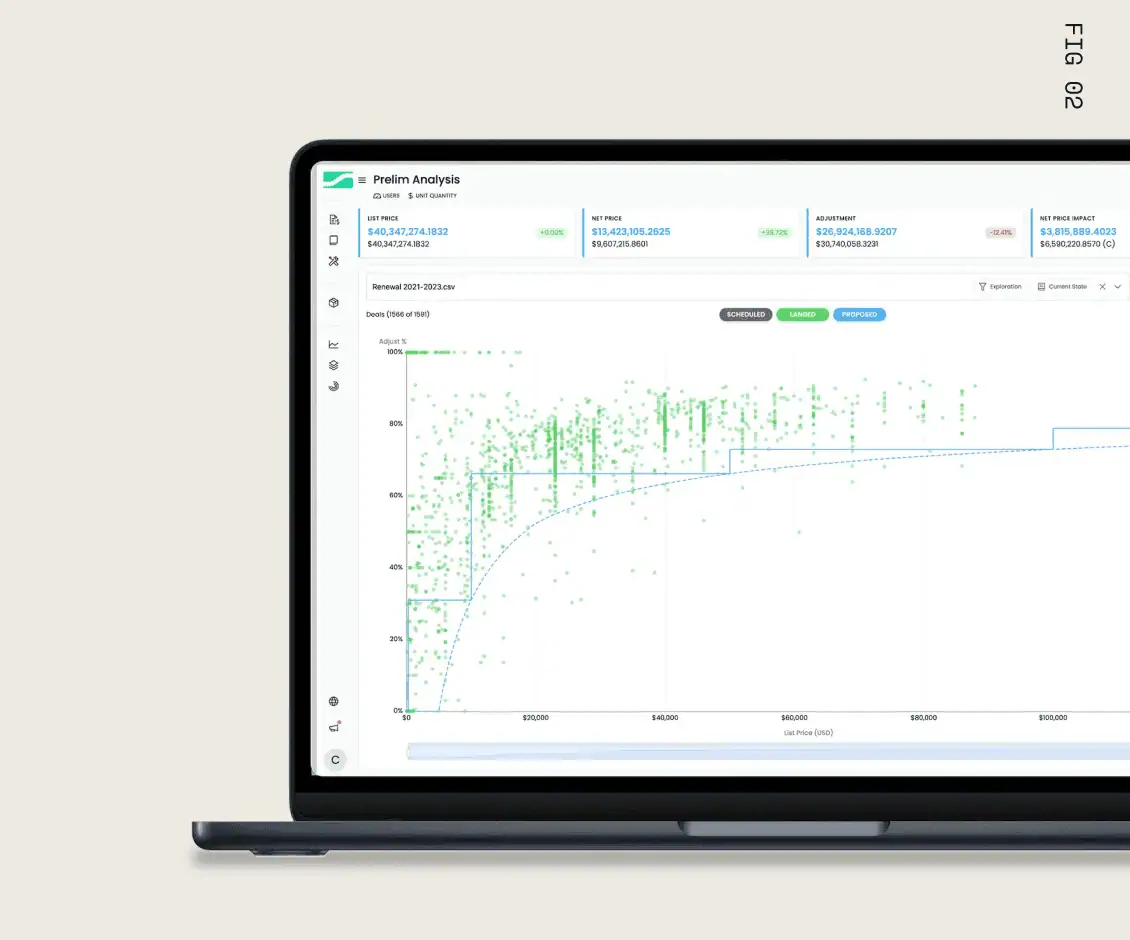
This is what runs inside LevelSetter:
Customer transition
modeling
Every active contract mapped against the new system: pricing migrations, renewals, grandfathering and custom transitions surfaced before deal cycles start. The work that determines whether the change ships at all.
Competitor
triangulation
What comparable customers paid for comparable products in your competitive set. Triangulated across signals (deal patterns, structured dialogue, public filings) so the new model plays out in the field, not just in the deck.
Self-serve
API
Pricing models accessible via API. Drive in-app self-serve pricing flows, track what prospects explore before they bail or close, and feed those patterns back into the next iteration. The model sharpens with every prospect that touches it.
Customer
budgeting
For highly variable value metrics: embed LevelSetter directly into your software and admin control panels. Your customers tour the pricing model on their own, forecast next year’s spend, and plan with confidence. Powered by the AWS backbone.
Integrations
LevelSetter speaks the systems your revenue org already runs on. Native integrations with Salesforce, Zoho, HubSpot, and the major CRMs surface pricing-aware quoting inside the deal flow your reps already know. Plus billing systems, ERPs, and data warehouses — pricing intelligence flows where the deal lives, not in another tab.
DEFEND your
value.
Deploy through Guardrails. Pricing stops being a project and becomes a continuous capability.
The simulation from DEFINE becomes your live baseline. LevelSetter watches every closed deal against it and flags drift at deal stage, before the renewal cycle decides for you. LevelSetter senses all the time; people decide, through the approval gates, discount guardrails and quoting rules of the deal desk. The pattern library keeps learning from every deal.

This is what runs inside LevelSetter:
Guardrails
The integrated deal-desk capability inside LevelSetter: approval gates and discount guardrails your deal desk sets from your own deal history. Approval policies routed to user pools or named individuals, automated escalation, mobile margin alerts, real-time net-price visibility. Standard deals close fast; only real exceptions escalate. The discount logic Guardrails enforces is margin-calibrated discounting — a continuous surface tied to gross margin, not a tier-step policy table.
Quoting
system
No CPQ rip-out required. LevelSetter’s integrated quoting runs invisibly behind your existing sales motions, or surfaces as the deal tool salespeople reach for on their own. Built for fast deployment, not a six-month CPQ rollout; some clients retire the CPQ later, once this layer has absorbed it.
Pricing
Studio
The sales-side workspace inside LevelSetter. Walk a prospect through the pricing architecture in real time, spin off options on the fly, compare deal economics side by side, roll back to any version. The dreaded price call becomes a dreamy one — and sales reps build the fluency to talk dollars without spooking themselves or the buyer.
Monitoring
Pricing-architecture deviation drift, assumption staleness, buyer-behavior shifts, ethically-sourced competitive moves — the pre-deal signals billing systems and CRMs can’t see. Trajectory becomes adjustable in real time.
Refusals
Every quote moves through versions, and most quoting systems keep only the one that signed. The versions a buyer walked away from are the larger record, and the only record of where a price stopped working. Refusals reads that record and names what it finds: patterns matched against decades of quoting records, each with its evidence, its position against what we see at that size, a figure where there is one, and an owner. Win/loss holds one row per deal and records the final offer; Refusals holds many rows per deal, including the deals you won. CPQ reporting measures execution; Refusals measures evidence.
Built for sprint-based
pricing decisions.
← scroll →
Traditional engagements run 6 to 12 months and deliver a report. LevelSetter sprints deliver validated changes every 1–3 weeks.
Where most pricing
systems go blind.
Most pricing tools generate an output and ship it. LevelSetter sits in the layer under the buying motion — sales-led, self-serve, hybrid — and records what buyers actually do with the offer. The quote-level record of what buyers did that product-led vendors typically lose, the configuration attempts the CRM never captures, the economic narratives that survive procurement because they’re calibrated against your own transactions instead of written once and shipped.
Win/loss records
in product-led motions
In product-led and self-serve motions, vendors usually don’t see who quoted but didn’t buy, which packaging combinations were attempted, or where buyers abandoned the configurator. LevelSetter drives the price on your website and records every quote attempt. The quote-level win/loss signal product-led vendors normally lose becomes a data feed you can act on.
Pre-quote behavior
the CRM never captures
The CRM shows what was sold. LevelSetter shows every package combination the buyer tried before landing, including the ones that didn’t convert. Edition flips, discount probes, abandoned quotes, configuration paths. Where pricing strategy gets validated is in the actions buyers take before they commit, not in the closed deals you already won.
One base across
sales-led and self-serve
Sales-led teams use LevelSetter to drive structured quotes through deal desk. Self-serve teams use LevelSetter to drive the price on the website. Both motions write into the same base — same licensing-metric layer, same packaging boundary, same transaction-data fabric. Quote-level win/loss patterns calibrate the bounds for the next quarter regardless of where the deal was forged.
ROI defense as
a byproduct of the live data
CFO-ready economic narratives don’t survive procurement when they’re written once and shipped. LevelSetter produces them as a byproduct of that layer, calibrated against the same deal records that drive your pricing decisions. The economic walkthrough holds because the seller (or the website) is fluent in the architecture that produced it, not because an AI generated a slide.
What runs underneath. The model is fitted to SPP’s pattern library of B2B software deals rather than a general model with a prompt in front of it. Your deals sit in your own separate store, kept apart by structure rather than by a permission setting. Every simulation can be replayed against the version it ran on. The AI does the sensing and the pattern matching. The arithmetic runs on deterministic routines, the same answer every run. People decide.
What changes when
LevelSetter is running.

OSISoft
Acquired by AVEVA (Schneider Electric) for $5B. Pricing architecture survived PE-level due diligence five years post-engagement.

BeyondTrust
Acquired by Francisco Partners for $5.4B. Largest cybersecurity PE deal of 2023. Pricing governance built for enterprise deal complexity.

BambooHR
Stalled at $22M ARR before SPP. North of $180M ARR soon after. Restructured licensing, packaging, and pricing that held as deal complexity scaled.
Your data doesn’t
need to be clean.
Most companies hesitate because their data is messy. LevelSetter was built for real-world data, not textbook data.
SKU
complexity
Complicated SKU structures, inconsistent formats, on-prem and cloud SKUs side-by-side, exports from systems that no longer exist. LevelSetter’s data transformation normalizes the mess automatically.
Missing
fields
Incomplete records, gaps in deal history, no solid pricebook versioning. LevelSetter infers structure from what exists rather than requiring clean inputs.
Pricebook
reconstruction
LevelSetter reverse-engineers your pricebook and reconstructs the time-series view of how deals have actually been forged across every customer, every package, every year. Even when no clean pricebook history exists, LevelSetter delivers the full audit trail.
Start with your own numbers. Pricing Ground Truth reads your closed deals and your price list, same day from intake-complete: what you really charge, where realized price leaks, and the pricing architecture you run. A fixed fee of $15,000, credited in full to whatever comes next.
Start Pricing Ground Truth Or talk it through firstFrequently asked questions
Strategy and infrastructure from the same team.
Designed by the pricing experts who build your architecture, operated by your team every day.
4 minutes, instant scorecard. No sales call.