

TL;DR
Freemium SaaS can fuel rapid user acquisition, but success depends on designing free tiers that deliver real value while creating natural upgrade triggers tied to business growth. This guide explains when the freemium SaaS model works, how it differs from free trials, and what metrics and strategies B2B companies must track to drive profitable conversions.
The freemium SaaS pricing model creates a challenging balancing act for B2B software companies. Most B2B companies get freemium wrong by giving away too much value (making upgrades unnecessary) or providing too little functionality (causing users to abandon the product before experiencing its benefits).
This guide shows you exactly when the freemium SaaS business model works for B2B companies and when it doesn’t.
What Is the Freemium SaaS Model?
The freemium SaaS model gives users permanent access to your core product features without any upfront payment, but with advanced functionality locked behind paid plans. Unlike traditional software licensing, users keep their free access indefinitely, only upgrading when their business needs outgrow what the free tier offers.
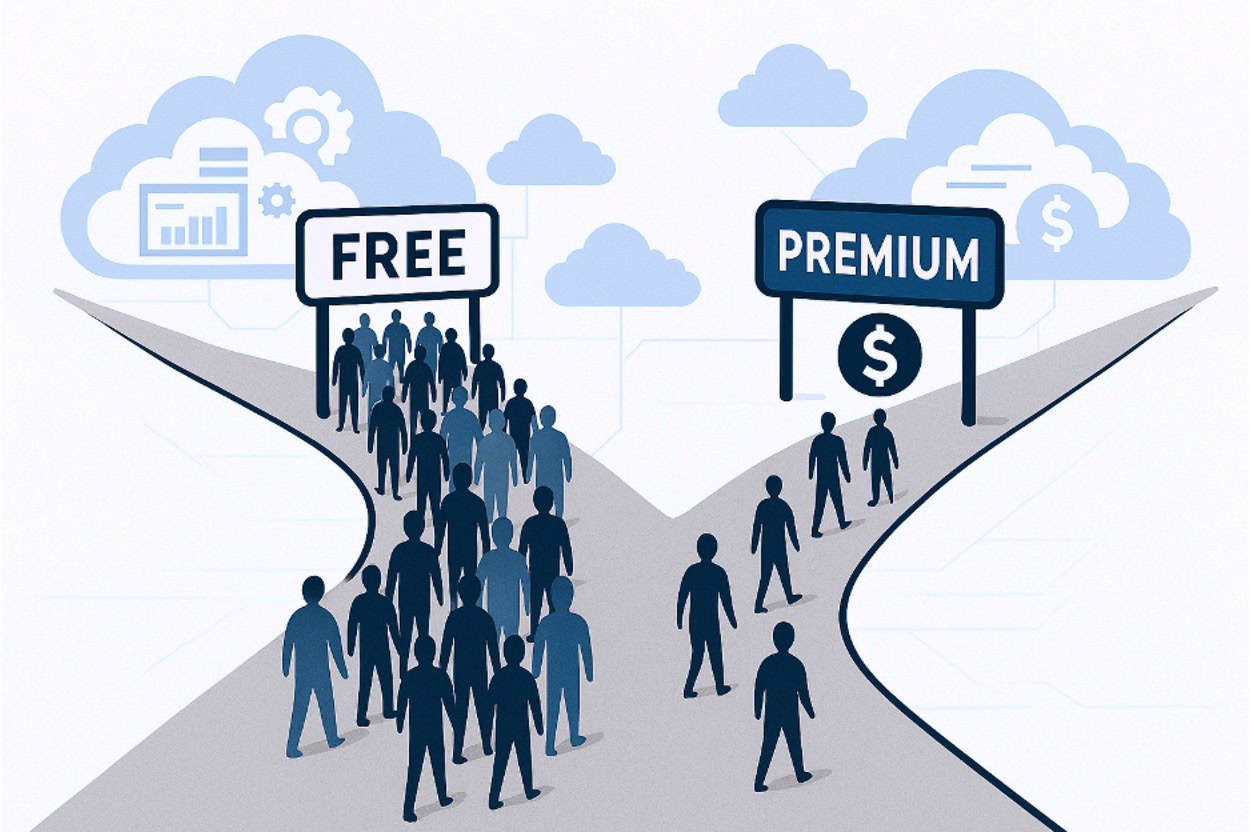
The conversion mechanics work completely differently from free trials. Trials create urgency through potential feature loss and are often timebound, while freemium relies on users naturally hitting limits as their needs expand. This is the cornerstone of Product Lead Growth (PLG): letting the product itself drive the sale rather than a sales team. This shows up clearly in the numbers: Trial conversion rates typically hit 15-20% for B2B SaaS, while freemium conversions usually land between 2-5%. However, freemium generates significantly more qualified leads because the signup process has almost no friction.
Building a successful freemium B2B SaaS product requires getting three things right:
- Your free tier must provide genuine business value.
- You need clear triggers that drive upgrades.
- Your economics must actually work long-term.
The free version can’t just be a glorified demo. It needs to solve real problems while creating natural expansion points.
Feature restrictions typically work better than usage limits for B2B audiences.
Strategic Benefits and Challenges of Freemium Pricing
The freemium SaaS business model presents both tremendous opportunities and hidden challenges that can make or break your growth strategy. Getting it right means understanding not just the upside potential but also the operational realities that many companies discover too late.
User Acquisition and Market Penetration Advantages
The freemium SaaS model eliminates the single biggest friction point in B2B sales: asking prospects to pay before they understand your value. When you remove upfront costs and lengthy sales processes, signup rates typically jump at least twice compared to trial-only approaches.
This creates something even more valuable than immediate conversions: genuine advocacy. Free users who find real value recommend your product during team meetings, share it with industry contacts, and create the kind of authentic word of mouth that no advertising budget can buy.
Revenue Generation Through Conversion Funnels
The best freemium B2B SaaS companies engineer specific pathways that naturally guide users toward paid plans. When users need to add team members, integrate with existing tools, or handle increased volume, they’re already seeing enough value to justify the investment.
Common Pitfalls and Resource Requirements
Every free user costs money to support. Without proper cost controls, you can end up subsidizing users who will never convert while stretching resources too thin to serve paying customers well.
Here’s how high-converting approaches differ from strategies that typically fail.
| Success Factor | High-Converting Approach | Common Mistake |
|---|---|---|
| Free Tier Value | Solves real problems, creates dependencies | Too basic to demonstrate value |
| Upgrade Triggers | Tied to business growth metrics | Arbitrary usage limits |
| Cost Management | Clear economics and conversion targets | Unlimited support for free users |
| Feature Strategy | Advanced capabilities behind paywall | Core functionality restricted |
Making the SaaS freemium model work requires self-service onboarding that actually works, automated support systems that resolve common issues, and analytics that identify which free users are most likely to convert.
Implementation Guidelines for B2B SaaS Companies
Choosing whether to implement a freemium SaaS model requires a thorough evaluation of your market position, cost structure, and growth objectives.
When to Choose a Freemium SaaS Model
The freemium SaaS business model performs best when your product delivers immediate value and targets users who will naturally exceed free tier limitations. Companies with network effects or viral growth potential see significant benefits, since free users drive organic acquisition through referrals and recommendations.
Skip freemium if you already maintain low customer acquisition costs through other channels, your product needs heavy onboarding support, your core value can’t be effectively demonstrated in a limited version, or free users consume expensive resources like storage or processing power.
Feature Limitations vs. Value Restrictions
The most successful freemium B2B SaaS strategies limit advanced capabilities while preserving core functionality. Rather than restricting basic features like file storage or user accounts, it’s best to focus on advanced integrations, reporting tools, or collaboration features that become essential as businesses grow.
Go Deeper
Most firms say they do software pricing. But choosing the right partner means asking sharper questions, the kind that reveal whether they bring real SaaS experience, work the way your team works, and can help turn pricing into a repeatable, evolving advantage.

Conversion Path Design and Optimization
Building effective conversion paths means understanding exactly when and why users encounter limitations that prompt upgrade decisions. Here’s how to create conversion paths that actually drive results:
- Map user journey stages: Identify specific actions that indicate growing engagement and business value, such as creating multiple projects or inviting team members.
- Define upgrade triggers: Set limitations that users naturally encounter as their usage patterns mature, like advanced reporting needs or team collaboration requirements.
- Create contextual upgrade prompts: Show upgrade options when users attempt to access restricted features, explaining the business benefits rather than just listing features.
- Implement progressive disclosure: Gradually introduce premium features through limited-time access or preview modes that demonstrate value before requiring payment.
- Track conversion analytics: Monitor which triggers drive the highest conversion rates and optimize your limitation strategy based on actual user behavior.
Measuring Success and Optimizing Your Freemium Strategy
Running a successful freemium SaaS business means tracking the right metrics: ones that actually predict user behavior and conversions, not just impressive signup numbers.
Essential Metrics for Freemium Performance
Focus on tracking how quickly new users complete meaningful actions that show that they understand your product’s value, like creating their first project, inviting team members, or importing data from their current tools. Time to value becomes especially important when users aren’t paying anything up front.
Pricing Intelligence and Data-Driven Decisions
The best freemium B2B SaaS companies use data to pinpoint exactly when users hit their natural upgrade triggers. The real value comes from connecting user behavior data with actual conversion events to predict who’s most likely to upgrade next. Products such as Pendo and MixPanel do a great job of tracking in-product usage so that Product Managers can get a better sense for how users are engaging and the value they are receiving. Product Marketers can deliver in-app messaging to inform of new features and nudge users to try new areas of the product to help move them to a new tier.
Continuous Optimization Through Advanced Analytics
The SaaS freemium model demands ongoing experimentation with feature restrictions, upgrade prompts, and conversion pathways. Test different limitation strategies against actual user behavior rather than theoretical assumptions about what should drive upgrades. Run cohort analyses to understand how changes affect different user segments over time.
Here’s how to organize your optimization efforts around the metrics that matter most.
| Metric Category | Key Indicator | Optimization Focus |
|---|---|---|
| User Activation | Time to first value realization | Reduce onboarding friction |
| Feature Engagement | Usage depth across free features | Identify upgrade trigger points |
| Conversion Signals | Frequency of premium feature attempts | Time upgrade prompts effectively |
Advanced platforms like LevelSetter enable continuous optimization through real-time visibility into how pricing changes affect user behavior across different segments. This allows companies to adjust their freemium SaaS models based on actual performance data rather than waiting for quarterly reviews of static metrics. Contact us to learn how data-driven pricing intelligence can optimize your freemium conversion strategy.
Conclusion
The freemium SaaS business model works best when you match your free tier restrictions to how businesses naturally expand their operations. Start by checking if your current costs and user journey can support a profitable freemium SaaS model. Run small tests with different restriction approaches, track how these changes impact both conversion rates and long-term customer value, and then expand the methods that drive profitable growth.